Download the full PDF here
With children always on the run, between school assignments and screens and social activities, it is easy to have an overstimulated and restless mind. As parents, we tend to want to have them a pause button- a means of letting them re-charge, concentrate and just breathe.
A surprisingly simple method of doing that is one of the most effective, science-supported, which is spending mindful time in nature. The Pocketful of Peace activity will make you look outdoors and transform a simple walk into a big mindfulness and writing exercise that can help your child slow down, pay attention, and reconnect with the world and himself or herself. It is not a simple walk, it is a slow walk towards relaxation, concentration and emotional stability.
The Purpose of the Mindful Nature Walk
The conscious walk in nature will help to change the distracted mind of your child to the conscious one. This can be a drastic change in emotional well-being, creativity, and concentration in the modern busy world. The following is what makes it so valuable:
1. Mindfulness and Stress Reduction
The very basic guidelines, walk slowly, breathe deeply, observe what surrounds you, serve as a guided meditation. Being mindful makes the brain slow down, and reconnects with the senses, which inherently lowers the anxiety and enhances concentration. Even a brief 10-minute nature walk can be used to control emotions and re-establish attention spans.
2. Developing Close Observation
The activity makes your child seek natural objects in certain colors, red, yellow, green, gold, brown and blue. This makes the walk a little adventure in details observation. Your child could not view a tree but would notice a crimson border of a fallen leaf or the sparkling blue hue on the feather of a bird. Such little acts of attention make one more attentive and develop curiosity.
3. Encouraging Sensory Engagement
Nature journaling encourages children to use all their senses: help them listen to the sound of the rustling leaves, smell of wet soil or feel the bark or pebbles. This whole body sensory experience revives concentration and a relaxing presence.
4. Fostering Creativity and Reflection
The last section of the activity, the Meaning I Found, makes the children consider what their chosen object could say, assuming that it could whisper a message of calm. This assists children in relating what they see to what they feel (what they sense inside). In the long run, it enhances emotional sensitivity, figurative thinking, and self-expression.

How to Guide Your Child Through the Two-Part Journal
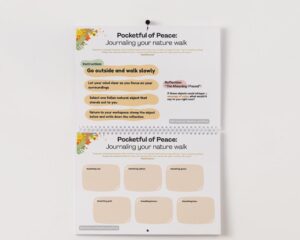
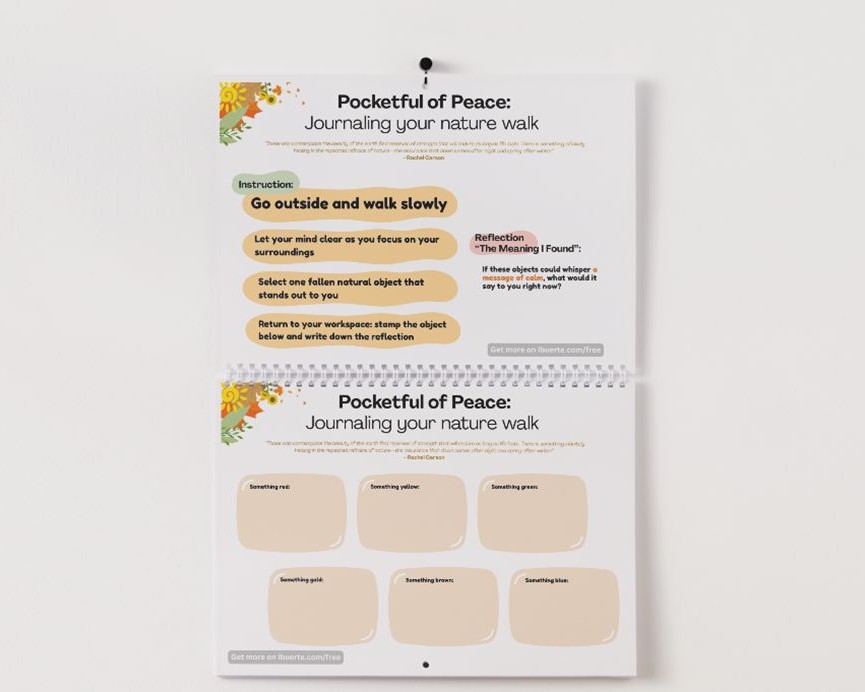
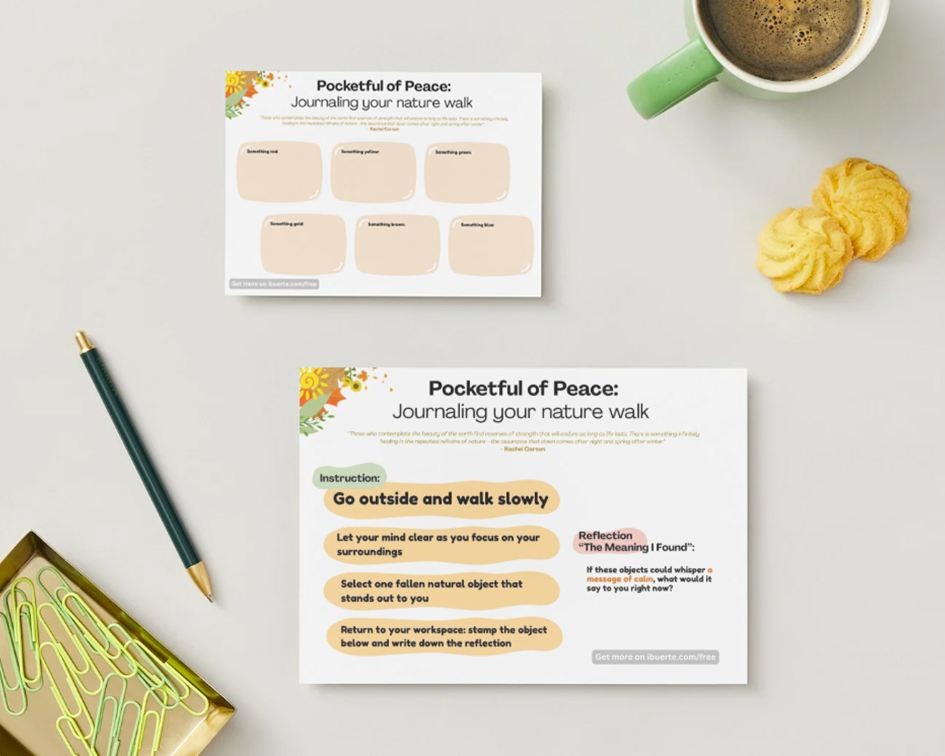
The Pocketful of Peace activity involves two pages of the journal, one of which is the reflective walk and the other one is a color scavenger hunt. The combination of these elements produces an equalizing effect of movement, concentration, and contemplation.
Part 1: The Guided Walk and Found Object
Step 1: Go Outside and Walk Slowly
Encourage your child move as a detective- silently and deliberately. Ask them to pay attention to what is under their feet, the sensation of the wind, and the sounds that are around them.
Step 2: Select One Fallen Natural Object
This may be a smooth pebble, a curved twig, a feather or even a seed pod. Allow the object to pick them, something that just feels like picking up.
Step 3: Reflect on the Message
The journaling prompt asks:
“If these objects could whisper a message of calm, what would it say to you right now?”
Parent Tip: Demonstrate the process of reflection. You could say, I suppose you could say, to your child, who has chosen a round and smooth rock, that perhaps this rock is reminding you to keep still and calm even when things get rough. The idea is to make them be able to transfer physical characteristics (smooth, strong, light) into emotional ones (calm, resilient, peaceful).
Part 2: The Color Scavenger Hunt
The second journal page is a proposal to your child to find six colors in nature Red, Yellow, Green, Gold, Brown, and Blue. They are able to draw or describe what they observe rather than gathering these items.
This promotes carefulness and keen observation. As an illustration, they may see the golden glitter of sunshine on a leaf or the rich brown design of tree bark.
Parent Tip: The color list provides structure and focus to children who easily get distracted. It is also a fast victory- they will be satisfied when they locate every color and complete their page.
Making It a Family Habit
You do not need to live close to a forest to reap the benefits of this practice, your backyard, a city park, or even a neighborhood garden will do the trick. It is important to make it a routine, casual family ritual.
1. Have a Post-Activity Conversation
When you are through, open-ended questions such as:
“Which color was easiest to find and why?”
“What message did your ‘Pocketful of Peace’ object give you today?”
Such thoughts allow children to relate their experiences to feelings and values.
2. Create a Nature Shelf
At home, find a small shelf or jar where your child can store his/her found objects. It is always nice to go back to them and be reminded of some peaceful moments and conscious discoveries.
3. Model the Practice
Children are a reflection of their surroundings. You also learn to be mindful when you practice with them to slow down, observe the details or write down your own thoughts.
Pocketful of Peace nature journaling activity is not just a walk, but it is a way to help children reconnect to the present moment, pay attention to details, and relax in the small things.
When you make nature strolls a time of observation, you are actually showing your child to see that peace does not always have to be distant and far away, but can also be the color of a leaf, the form of a rock, or the silent breath of the wind. By slowing down to observe, your child will not only be able to find the beauty of the surrounding world, but also find the serenity, power, and concentration of the inner world.