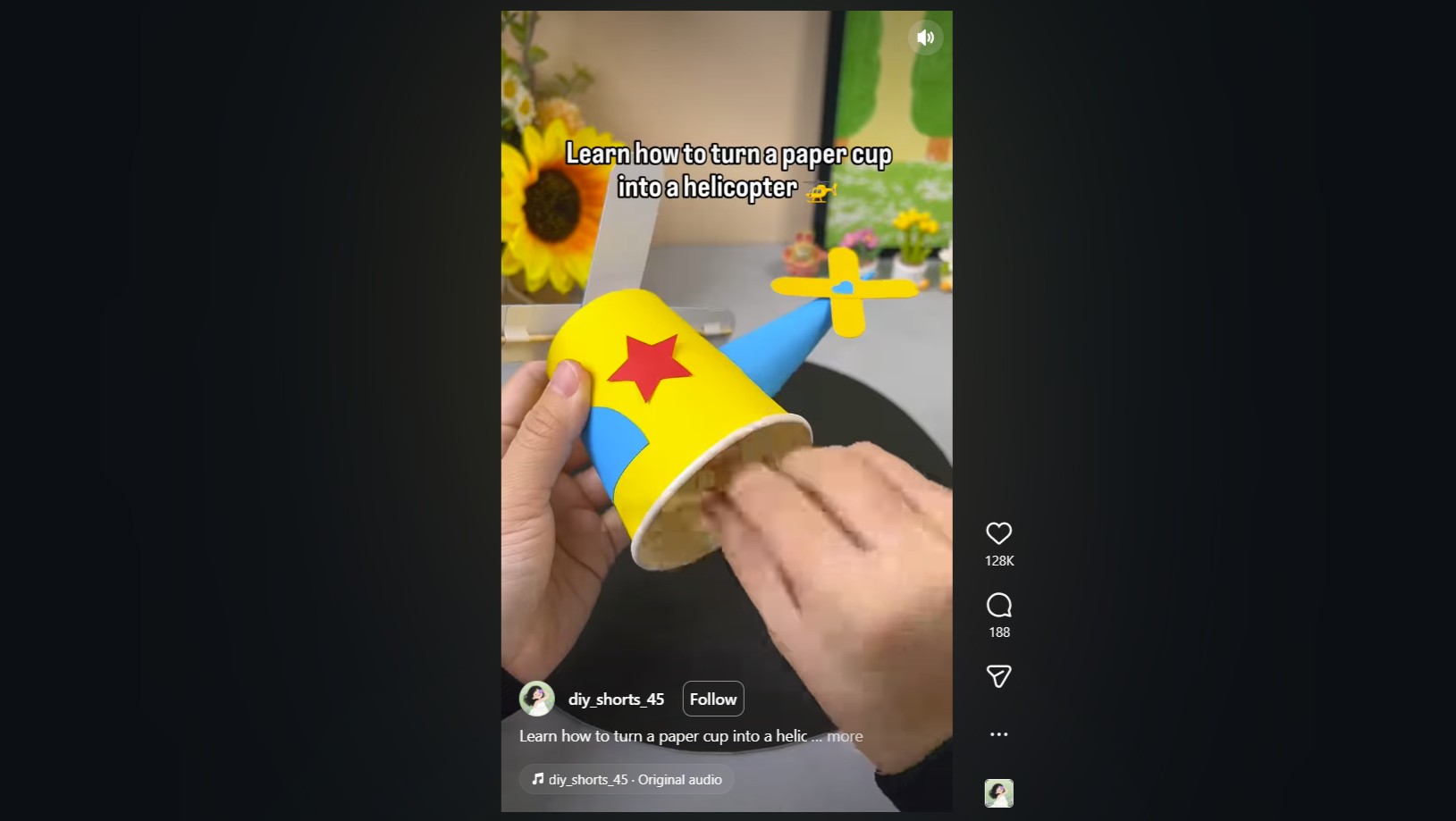
My daughter looked at the crumpled paper cup on the table and shrugged. “It’s just a cup, Mum.” Three minutes later, it was spinning in the air like a tiny helicopter and she couldn’t stop giggling.
That’s the thing about this project. It looks impossibly simple, almost too basic to work. And then it does work, and suddenly your kid wants to build five more.
What You Need and How Long It Takes
Setup time: Under five minutes
What you’ll need:
- 2 paper cups (the cheap thin ones work best)
- Scissors
- A pencil or small stick
- An open space to drop it from
No glue, no tape, no special kit. Just stuff you already have in a kitchen drawer.
How to Build It
Step 1: Stack the two cups together with the rims facing the same direction. The bottom cup is your body.
Step 2: Cut four slits evenly spaced around the rim of the top cup. Each slit should be about 3cm long.
Step 3: Fold each cut strip outward at a slight angle. These become your rotor blades.
Step 4: Poke a pencil through the very center of the stacked cups and slide them down to the bottom third of the pencil. This is your axle.
Step 5: Drop it. The cups will spin as they fall.
That’s the whole build. Seriously.
Simple materials, impressive results
The Physics Bit (Without Making It Boring)
Here’s what actually happens when you drop it.
Air pushes against the angled rotor blades as the cup falls. Because the blades are cut and angled asymmetrically, the air makes them spin. The faster it falls, the faster it spins.
Your kid doesn’t need to know this for it to be fun. But if they ask, a simple explanation works perfectly. “The air pushes the blades and makes them spin, just like a real helicopter, only a real helicopter pushes air down to go up.”
Which brings me to something important.
A Note on That Viral Disclaimer
If you’ve seen this craft on social media, you might have noticed creators clarifying something important. The spinning cup helicopter won’t fly. It’s not a drone. It won’t lift off the ground on its own.
As one creator put it with a laugh: “For those of you who are new to physics, it won’t fly. It is being lifted from the back for illustration and fun purposes only.”
This is honest and worth sharing with your kids. The helicopter spins, but it falls down. That’s gravity working. And actually, noticing that, asking why it spins but still falls, that’s the best kind of science question.
What Kids Actually Learn
- Air resistance — they feel it work
- Gravity — it falls every single time
- Motion and rotation — watching what makes it spin faster or slower
- Cause and effect — steeper angle, faster spin
- Fine motor skills — cutting, folding, building
All of it through a five-minute craft that costs nothing.
Experiment Ideas
Once the basic build works, challenge your kid to try variations:
- Cut the blades at different angles
- Use one cup vs. two cups
- Try dropping from different heights
- Time how long it takes to fall and spin
The experiments are endless and all of them are free.
Video Demo
What Parents Are Saying
“For those of you who are new to physics, it won’t fly. It is being lifted from the back for illustration and fun purposes only 🤩”
— @dinksmini · Instagram
“That’s so good, perfect for my new venture supporting home schoolers outside of the current education system, feel free to follow to find out more x”
— @shonalivingston_rowe · Instagram
Who This Is For
This is a great first craft for younger kids who can’t use scissors confidently yet, because the cuts are simple and forgiving. It’s also perfect for older kids who want to experiment and learn through trial and error.
Teachers and homeschool parents love this one too. It takes almost no prep, uses almost no supplies, and teaches real physics concepts without a textbook in sight.
The Bottom Line
Two paper cups and a pair of scissors. That’s the entire supply list. Five minutes later, your kid is dropping their creation, watching it spin, and accidentally learning about air movement and gravity.
Sometimes the best STEM activities are the cheapest ones.
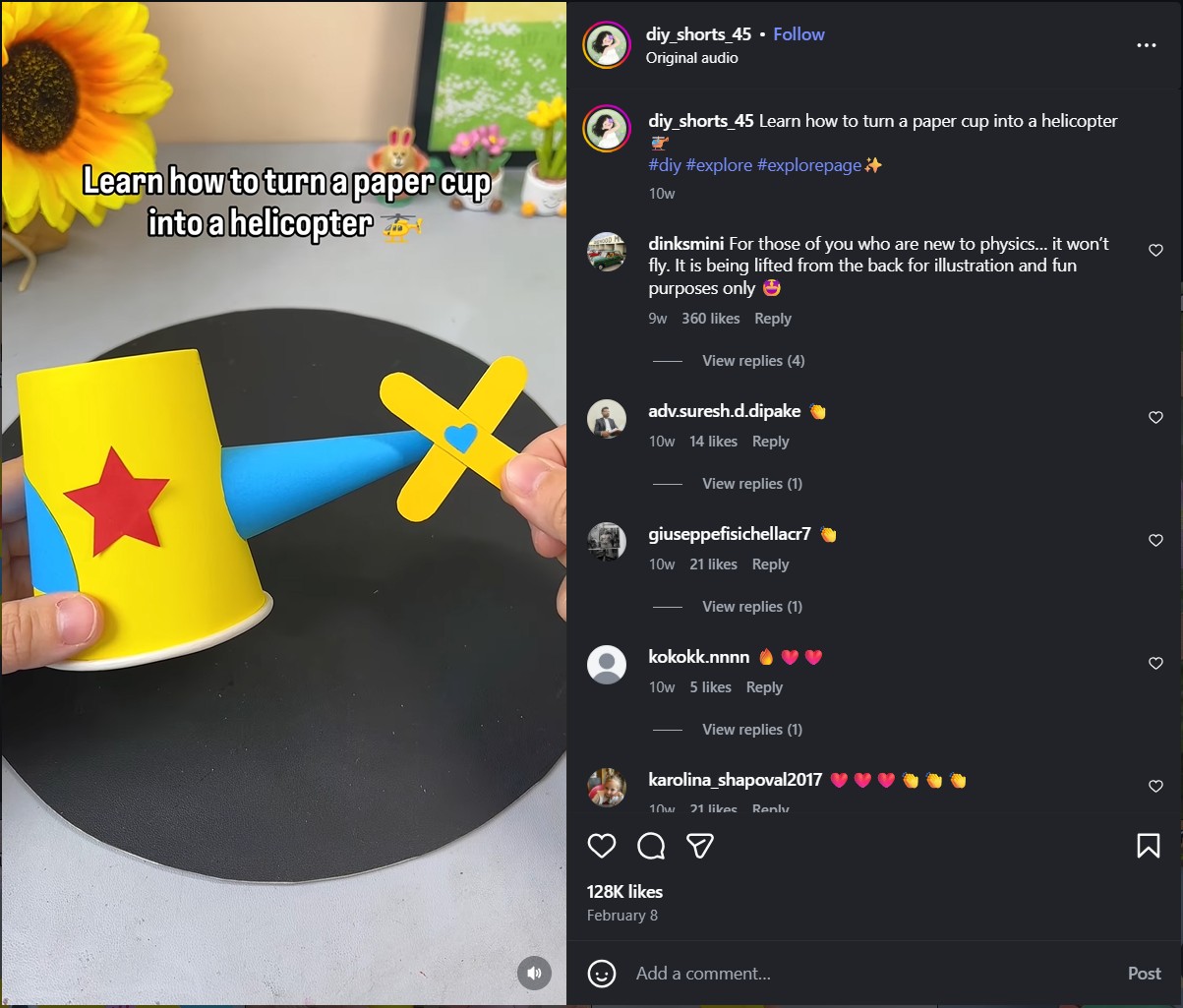 The finished helicopter spinning on its way down
Sarah writes about playful learning and simple activities that actually work. This post reflects real experience testing activities with her kids.